
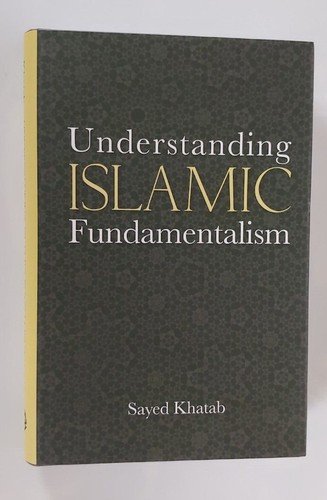
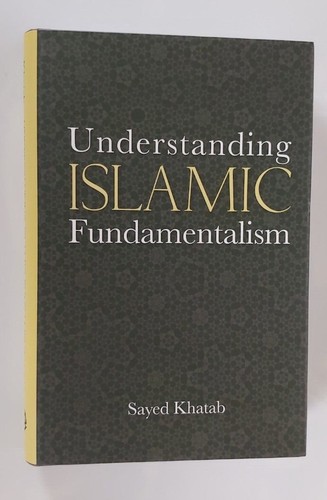
Item specifics
- Condition
- Very GoodA book that does not look new and has been read but is in excellent condition. No obvious damage to the cover, with the dust jacket (if applicable) included for hard covers. No missing or damaged pages, no creases or tears, and no underlining/highlighting of text or writing in the margins. May be very minimal identifying marks on the inside cover. Very minimal wear and tear. See the seller’s listing for full details and description of any imperfections. See all condition definitionsopens in a new window or tab
- Seller Notes
- “In very good condition with dust cover wear, pages unmarked.”
- Country of Origin
- Egypt
- Narrative Type
- Nonfiction
- Features
- Dust Jacket
- Intended Audience
- Adults
- ISBN
- 9789774164996
- Book Title
- Understanding Islamic Fundamentalism : The Theological and Ideological Basis of Al-Qa’ida’s Political Tactics
- Publisher
- American University in Cairo Press
- Item Length
- 6.1 in
- Publication Year
- 2011
- Format
- Hardcover
- Language
- English
- Item Height
- 1.1 in
- Author
- Sayed Khatab
- Genre
- Religion, Political Science, History
- Topic
- Islam / General, Political Ideologies / General, Middle East / General
- Item Weight
- 25.8 Oz
- Item Width
- 9.2 in
- Number of Pages
- 320 Pages
Understanding Islamic Fundamentalsim by Sayed Khatab, 2011
About this product
Product Identifiers
Publisher
American University in Cairo Press
ISBN-10
9774164997
ISBN-13
9789774164996
eBay Product ID (ePID)
103791875
Product Key Features
Book Title
Understanding Islamic Fundamentalism : The Theological and Ideological Basis of Al-Qa’ida’s Political Tactics
Number of Pages
320 Pages
Language
English
Topic
Islam / General, Political Ideologies / General, Middle East / General
Publication Year
2011
Genre
Religion, Political Science, History
Format
Hardcover
Dimensions
Item Height
1.1 in
Item Weight
25.8 Oz
Item Length
6.1 in
Item Width
9.2 in
Additional Product Features
Intended Audience
Trade
LCCN
2011-278314
Reviews
“This book is an important contribution to political Islamic thought from a historical to contemporary perspective, and in the English language, there is nothing that compares. This book is a jewel . . . it will be beneficial to all English readers as a reference to understanding the nature and development of Fundamentalist Islamic thought from a religious perspective. This book will give the English reading audience-from academics, students, diplomats, to basically anyone interested in this topic-access to knowledge that is normally reserved for a Muslim audience who have a strong knowledge of Arabic and Islam: in other words, a normally exclusive group.” -Maye Kassem, Associate Professor, Department of Political Science, The American University in Cairo
Table Of Content
Acknowledgements Introduction 1: Islamic Fundamentalism The Nature of the Challenge 2: The Origins of Fundamentalism Kharijism Ibadism Hanbalism Wahhabism 3: From Fundamentalism to Neo-Jihadism 4: Al-Qa’ida Bin Laden From Jihad to Terrorism Towards the Formation of al-Qa’ida The Mullah and the Hidden Imam 5: Al-Qa’ida’s Ideology Jihad: Muslim Consensus Al-Qa’ida: Neo-Jihad The Offensive Jihad The Defensive Neo-Jihad Neo-Jihad against the Rejectionists Who Declares Jihad? The Neo-Jihad is Outdated 6: Al-Qa’ida’s Tactics Tactical Goals of 9/11 Tactics after 9/11 The Plan of Action Principles of Military Actions Political Games Al-Tatarrus and the Killing of Civilians 7: Inside al-Qa’ida: The Ideological War Dr Fadl Criticism of al-Qa’ida’s Theology and Ideology Stages in al-Qa’ida’s Establishment Egyptian Jihad in al-Qa’ida Mullah Umar, Bin Laden, and 9/11 Bin Laden and al-Zawahiri should be Tried American Foreign Aid Al-Qa’ida’s Response to Dr Fadl Conclusion Sovereignty (Hakimiyyah) Bibliography
Synopsis
Beginning with an examination of medieval Islamic fundamentalist movements such as Kharjism, Ibadism, Hanbalism, and Wahhabism, Sayed Khatab looks at the similarities and differences between them and present organizations such as al-Qa ‘ ida. It may be surprising that many of the radical narratives embraced by modern groups have not emerged recently. Identifying these roots can lead to a better understanding of al-Qa’ida’s theological and intellectual narratives, and how they effectively indoctrinate youths and attract many of them to violent acts of terrorism. The book then focuses on al-Qa ‘ ida’s theology, ideology, and tactics; the geographic contours and implications of al-Qa ‘ ida’s political strategy in relation to the western and eastern countries which are considered enemy states; the impending clash of cultures; and the ideological war within al-Qa ‘ ida. Innovative in its concept, examining political Islamic thought from a historical to a contemporary perspective, Islamic Fundamentalism generates new understanding of the many complexities of political Islam, and the role of violence and terrorism., Beginning with an examination of early Islamic fundamentalist movements such as Kharjism, Ibadism, Hanbalism, and Wahhabism, Sayed Khatab looks at the similarities and differences between them and present organizations such as al-Qa’ida. Identifying the roots of modern radical narratives can lead to a better understanding of al-Qa’ida’s theological and intellectual narratives, and how they effectively indoctrinate youths and attract many of them to violent acts of terrorism. Innovative in its concept, examining political Islamic thought from a historical to a contemporary perspective, Islamic Fundamentalism generates new understanding of the many complexities of political Islam, and the role of violence and terrorism., Beginning with an examination of medieval Islamic fundamentalist movements such as Kharjism, Ibadism, Hanbalism, and Wahhabism, Sayed Khatab looks at the similarities and differences between them and present organizations such as al-Qa’ida. It may be surprising that many of the radical narratives embraced by modern groups have not emerged recently. Identifying these roots can lead to a better understanding of al-Qa’ida’s theological and intellectual narratives, and how they effectively indoctrinate youths and attract many of them to violent acts of terrorism. The book then focuses on al-Qa’ida’s theology, ideology, and tactics; the geographic contours and implications of al-Qa’ida’s political strategy in relation to the western and eastern countries which are considered enemy states; the impending clash of cultures; and the ideological war within al-Qa’ida. Innovative in its concept, examining political Islamic thought from a historical to a contemporary perspective, Islamic Fundamentalism generates new understanding of the many complexities of political Islam, and the role of violence and terrorism.
LC Classification Number
BP166.14.F85
Price : 14.99
Ends on : N/A
View on eBay