
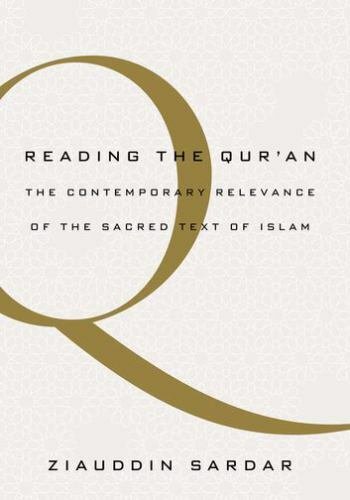

Item specifics
- Condition
- GoodA book that has been read but is in good condition. Very minimal damage to the cover including scuff marks, but no holes or tears. The dust jacket for hard covers may not be included. Binding has minimal wear. The majority of pages are undamaged with minimal creasing or tearing, minimal pencil underlining of text, no highlighting of text, no writing in margins. No missing pages. See the seller’s listing for full details and description of any imperfections. See all condition definitionsopens in a new window or tab
- Seller Notes
- “Used – Good”
- ISBN
- 9780190657840
- Book Title
- Reading the Qur’an : the Contemporary Relevance of the Sacred Text of Islam
- Publisher
- Oxford University Press, Incorporated
- Item Length
- 9.1 in
- Publication Year
- 2017
- Format
- Trade Paperback
- Language
- English
- Item Height
- 1.1 in
- Author
- Ziauddin Sardar
- Genre
- Religion
- Topic
- Islam / Koran & Sacred Writings, General
- Item Weight
- 21.2 Oz
- Item Width
- 6.1 in
- Number of Pages
- 432 Pages
- Country of Origin
- United States
Reading the Qur’an: The Contemporary Releva… 9780190657840 by Sardar, Ziauddin
About this product
Product Identifiers
Publisher
Oxford University Press, Incorporated
ISBN-10
0190657847
ISBN-13
9780190657840
eBay Product ID (ePID)
234892160
Product Key Features
Book Title
Reading the Qur’an : the Contemporary Relevance of the Sacred Text of Islam
Number of Pages
432 Pages
Language
English
Publication Year
2017
Topic
Islam / Koran & Sacred Writings, General
Genre
Religion
Format
Trade Paperback
Dimensions
Item Height
1.1 in
Item Weight
21.2 Oz
Item Length
9.1 in
Item Width
6.1 in
Additional Product Features
Intended Audience
Trade
Reviews
“This lucid, scholarly and exciting book could not be more timely; it takes the reader on a spiritual and intellectual journey that is essential for Muslim and non-Muslim alike and addresses some of the most pressing needs of our time.” -Karen Armstrong, author of A History of God and Muhammad: A Biography of the Prophet “[Sardar] is asking the right questions, and the health of the world community over the next couple of centuries may depend on how well, and how often, others in his faith ask the same questions.” – National Review “Sardar is passionate in his approach without being dogmatic. Will appeal to many open-minded readers of other faiths and those generally interested in spirituality.” –Booklist “If one could pick just one book to connect the Muslim past with its complex present and future potential, Reading the Qur’an would be that book. To use a metaphor from the eleventh-century exemplar of rational mysticism, Imam Ghazzali, both Muslims and non-Muslims must ‘sail into the endless ocean of its meanings,’ with Ziauddin Sardar the nimble captain on that voyage of hope and discovery.” -Professor Bruce Lawrence, Duke University “Sardar explores the Quran from a variety of perspectives, drawing fresh and contemporary lessons from the Sacred Text.” –Islamic Horizons “A helpful book for opening the minds of spiritually engaged readers interested in the place of holy books in today’s world.” — Library Journal, “This lucid, scholarly and exciting book could not be more timely; it takes the reader on a spiritual and intellectual journey that is essential for Muslim and non-Muslim alike and addresses some of the most pressing needs of our time.” -Karen Armstrong, author of A History of God and Muhammad: A Biography of the Prophet”[Sardar] is asking the right questions, and the health of the world community over the next couple of centuries may depend on how well, and how often, others in his faith ask the same questions.” – National Review”Sardar is passionate in his approach without being dogmatic. Will appeal to many open-minded readers of other faiths and those generally interested in spirituality.” –Booklist”If one could pick just one book to connect the Muslim past with its complex present and future potential, Reading the Qur’an would be that book. To use a metaphor from the eleventh-century exemplar of rational mysticism, Imam Ghazzali, both Muslims and non-Muslims must ‘sail into the endless ocean of its meanings,’ with Ziauddin Sardar the nimble captain on that voyage of hope and discovery.” -Professor Bruce Lawrence, Duke University”Sardar explores the Quran from a variety of perspectives, drawing fresh and contemporary lessons from the Sacred Text.” –Islamic Horizons”A helpful book for opening the minds of spiritually engaged readers interested in the place of holy books in today’s world.” — Library Journal”Challenging notions of interpretive eternality and textual justification for misogyny, hatred, and an obsession with rules and mindless rituals, Samman utilizes a diverse collection of interpretive methodologies: including traditional exegesis, hermeneutics, critical theory, and cultural analysis.”–Middle East Journal, “This lucid, scholarly and exciting book could not be more timely; it takes the reader on a spiritual and intellectual journey that is essential for Muslim and non-Muslim alike and addresses some of the most pressing needs of our time.” -Karen Armstrong, author of A History of God and Muhammad: A Biography of the Prophet “[Sardar] is asking the right questions, and the health of the world community over the next couple of centuries may depend on how well, and how often, others in his faith ask the same questions.” – National Review “Sardar is passionate in his approach without being dogmatic. Will appeal to many open-minded readers of other faiths and those generally interested in spirituality.” –Booklist “If one could pick just one book to connect the Muslim past with its complex present and future potential, Reading the Qur’an would be that book. To use a metaphor from the eleventh-century exemplar of rational mysticism, Imam Ghazzali, both Muslims and non-Muslims must ‘sail into the endless ocean of its meanings,’ with Ziauddin Sardar the nimble captain on that voyage of hope and discovery.” -Professor Bruce Lawrence, Duke University “Sardar explores the Quran from a variety of perspectives, drawing fresh and contemporary lessons from the Sacred Text.” –Islamic Horizons”A helpful book for opening the minds of spiritually engaged readers interested in the place of holy books in today’s world.” — Library Journal
Dewey Edition
22
Dewey Decimal
297.1/226
Table Of Content
Preface Prologue Part One: Overview 1. The Qur’an and Me 2. Style and Structure 3. Approach and Interpretations 4. Questions of Authority 5. The Limits of Translations Part Two: By Way of Tradition 6. Introduction 7. Al-Fatiha: Attributes of God 8. Al-FAtiha: ‘The Straight Path’ 9. Al-Baqara: The Qur’an and Doubt 10. Al-Baqara: ‘The Hypocrites’ 11. Al-Baqara: Paradise 12. Al-Baqara: Fall and Evil 13. Al-Baqara: ‘Children of Israel’ 14. Al-Baqara: A ‘Middle Community’ 15. Al-Baqara: Virtuous People 16. Al-Baqara: Law of Equity 17. Al-Baqara: Fasting 18. Al-Baqara: War and Peace 19. Al-Baqara: Hajj 20. Al-Baqara: Apostasy and Migration 21. Al-Baqara: Marriage and Divorce 22. Al-Baqara: Qualities of Leadership 23. Al-Baqara: Majesty of God and Freedom of Religion 24. Al-Baqara: Arguing with God 25. Al-Baqara: Charity and Usury 26. Al-Baqara: Witness 27. Al-Baqara: Prayer Part Three: Themes and Concepts 28. Introduction 29. Prophets and Revelation 30. Abrogation and Change 31. Time and History 21. Truth and Plurality 33. Humanity and Diversity 34. Individual and Community 35. Reason and Knowledge 36. Crime and Punishment 37. Rights and Duties 38. Nature and Environment 39. Ethics and Morality 40. Reading and Writing Part Four: Contemporary Topics 41. Introduction 42. The Shariah 43. Power and Politics 44. Polygamy and Domestic Violence 45. Sex and Society 46. Homosexuality 47. The Veil 48. Freedom of Expression 49. Suicide (Assisted or Otherwise) 50. Science and Technology 51. Evolution 52. Art, Music and Imagination Epilogue Notes and References Bibliography Index
Synopsis
“I grew up reading the Qur’an on my mother’s lap,” writes Ziauddin Sardar. “It’s an experience I share with most Muslim children. And so it is that our connection to the Qur’an is infused with associations of the warmest and most enduring of human bonds.” In Reading the Qur’an, Sardar – one of Europe’s leading public intellectuals – laments that for far too many Muslims, the Qur’an he had learned in his mother’s lap has become a stick used for ensuring conformity and suppressing dissenting views. Indeed, some find in the Qur’an justification for misogyny, validation for hatred of others, an obsession with dress and mindless ritual, rules for running modern states. Arguing passionately but reasonably against these trends, Sardar speaks out for a more open, less doctrinaire approach to reading the Qur’an. He contends that the Qur’an is not fixed in stone for all time, but a dynamic text which every generation must encounter anew, and whose relevance and implications for our time we have yet to fully discover. The words of the Qur’an imply movement: the religious life, it tells us, is not about standing still but always striving to make our life, our society, the entire world around us a better place for everyone. Sardar explores the Qur’an from a variety of perspectives, from traditional exegesis to hermeneutics, critical theory, and cultural analysis, drawing fresh and contemporary lessons from the Sacred Text. He also examines what the Qur’an says about such contemporary topics as power and politics, rights of women, suicide, domestic violence, sex, homosexuality, the veil, freedom of expression, and evolution. Ziauddin Sardar opens a new window on this remarkable Sacred Text, in a book that will engage all devout Muslims and will interest anyone curious about the Qur’an and Islam today., “I grew up reading the Qur’an on my mother’s lap,” writes Ziauddin Sardar. “It’s an experience I share with most Muslim children. And so it is that our connection to the Qur’an is infused with associations of the warmest and most enduring of human bonds.”, “I grew up reading the Qur’an on my mother’s lap,” writes Ziauddin Sardar. “It’s an experience I share with most Muslim children. And so it is that our connection to the Qur’an is infused with associations of the warmest and most enduring of human bonds.” In Reading the Qur’an, Sardar–one of Europe’s leading public intellectuals–laments that for far too many Muslims, the Qur’an he had learned in his mother’s lap has become astick used for ensuring conformity and suppressing dissenting views. Indeed, some find in the Qur’an justification for misogyny, validation for hatred of others, an obsession with dress and mindless ritual, rulesfor running modern states. Arguing passionately but reasonably against these trends, Sardar speaks out for a more open, less doctrinaire approach to reading the Qur’an. He contends that the Qur’an is not fixed in stone for all time, but a dynamic text which every generation must encounter anew, and whose relevance and implications for our time we have yet to fully discover. The words of the Qur’an imply movement: the religious life, it tells us, is not about standing still but always strivingto make our life, our society, the entire world around us a better place for everyone. Sardar explores the Qur’an from a variety of perspectives, from traditional exegesis to hermeneutics, criticaltheory, and cultural analysis, drawing fresh and contemporary lessons from the Sacred Text. He also examines what the Qur’an says about such contemporary topics as power and politics, rights of women, suicide, domestic violence, sex, homosexuality, the veil, freedom of expression, and evolution. Ziauddin Sardar opens a new window on this remarkable Sacred Text, in a book that will engage all devout Muslims and will interest anyone curious about the Qur’an and Islamtoday., In this enlightening and highly readable book, a leading British Muslim intellectual offers a refreshingly new interpretation of the Qur’an., “I grew up reading the Qur’an on my mother’s lap,” writes Ziauddin Sardar. “It’s an experience I share with most Muslim children. And so it is that our connection to the Qur’an is infused with associations of the warmest and most enduring of human bonds.” In Reading the Qur’an , Sardar–one of Europe’s leading public intellectuals–laments that for far too many Muslims, the Qur’an he had learned in his mother’s lap has become a stick used for ensuring conformity and suppressing dissenting views. Indeed, some find in the Qur’an justification for misogyny, validation for hatred of others, an obsession with dress and mindless ritual, rules for running modern states. Arguing passionately but reasonably against these trends, Sardar speaks out for a more open, less doctrinaire approach to reading the Qur’an. He contends that the Qur’an is not fixed in stone for all time, but a dynamic text which every generation must encounter anew, and whose relevance and implications for our time we have yet to fully discover. The words of the Qur’an imply movement: the religious life, it tells us, is not about standing still but always striving to make our life, our society, the entire world around us a better place for everyone. Sardar explores the Qur’an from a variety of perspectives, from traditional exegesis to hermeneutics, critical theory, and cultural analysis, drawing fresh and contemporary lessons from the Sacred Text. He also examines what the Qur’an says about such contemporary topics as power and politics, rights of women, suicide, domestic violence, sex, homosexuality, the veil, freedom of expression, and evolution. Ziauddin Sardar opens a new window on this remarkable Sacred Text, in a book that will engage all devout Muslims and will interest anyone curious about the Qur’an and Islam today.
Price : 13.96
Ends on : N/A
View on eBay