
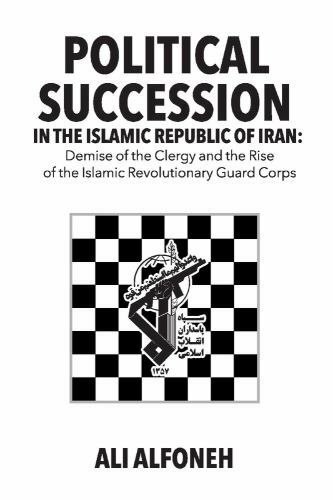

Item specifics
- Condition
- ISBN
- 9781098312152
- Book Title
- Political Succession in the Islamic Republic of Iran : Demise of the Clergy and the Rise of the Revolutionary Guard Corps
- Publisher
- BookBaby
- Item Length
- 9 in
- Publication Year
- 2020
- Format
- Trade Paperback
- Language
- English
- Item Height
- 0.5 in
- Author
- Ali Alfoneh
- Genre
- Political Science
- Topic
- World / General
- Item Weight
- 12.1 Oz
- Item Width
- 6 in
- Number of Pages
- 208 Pages
- Country of Origin
- United States
Political Succession in the Islamic Republic of Iran: Demise of the Clergy and
About this product
Product Identifiers
Publisher
BookBaby
ISBN-10
1098312155
ISBN-13
9781098312152
eBay Product ID (ePID)
15050079664
Product Key Features
Book Title
Political Succession in the Islamic Republic of Iran : Demise of the Clergy and the Rise of the Revolutionary Guard Corps
Number of Pages
208 Pages
Language
English
Publication Year
2020
Topic
World / General
Genre
Political Science
Format
Trade Paperback
Dimensions
Item Height
0.5 in
Item Weight
12.1 Oz
Item Length
9 in
Item Width
6 in
Additional Product Features
Intended Audience
Trade
Synopsis
What will happen after Iranian Supreme Leader Ayatollah Ali Khamenei’s passing? How is the factional struggle for power in Iran over succession of Khamenei, between technocratic elites within the regime led by President Hassan Rouhani on the one side, and the Islamic Revolutionary Guard Corps and its allies on the other, likely to impact the trajectory of the Islamic Republic and future of U.S.-Iranian relations? This book answers these questions, concluding that Khamenei’s successor, whoever he may be, will, for all practical purposes, be beholden to the IRGC, which also will decide the fundamental tenet in U.S.-Iranian relations. Based on this scenario, U.S. policymakers involved in shaping policies toward Tehran must take into consideration the implications of succession rivalries in the Islamic Republic. U.S. policymakers must also strategically plan how to face the challenges of a future transformation of the Islamic Republic into a military dictatorship, albeit one with a clerical figurehead., What will happen after Iranian Supreme Leader Ayatollah Ali Khamenei’s passing? How is the factional struggle for power in Iran over succession of Khamenei, between technocratic elites within the regime led by President Hassan Rouhani on the one side, and the Islamic Revolutionary Guard and its allies on the other, likely to impact the trajectory of the Islamic Republic and future of U.S.-Iranian relations? This book answers these questions. Following the introductory Chapter 1, Chapter 2 discusses how Grand Ayatollah Ruhollah Khomeini usurped power in Iran following the revolution of 1979 and became the leader of the revolution. Chapter 3 provides a comprehensive account of the struggle over succession during Khomeini’s lifetime and how Khomeini’s illness and secret relations with the United States paved Ayatollah Ali Khamenei’s path to leadership. Chapter 4 provides a comprehensive analysis of the factional struggle underway over Khamenei’s succession, and how external pressure from Washington under President Donald J. Trump and its allies may complete the transformation of the Islamic Republic into a military dictatorship dominated by the IRGC – although one led by a symbolic clerical figurehead. Chapter 5 discusses the impact of militarization of the Islamic Republic for the trajectory of U.S.-Iranian relations. Considering the succession following Khamenei, the book concludes: – In line with earlier instances, the rules and procedures for political succession enshrined in the Constitution of the Islamic Republic will be ignored and retroactively adjusted to legitimize the individual or group prevailing in the factional struggle over succession. – Relations with the United States( which deteriorated in the wake of the U.S. withdrawal from the Joint Comprehensive Plan of Action, or Iran nuclear deal) unilateral U.S. sanctions against the Islamic Republic, and incidents in the Gulf of Oman and the Persian Gulf since May 2019, will be a theme in the factional succession struggle. This is because of the (perhaps false) perception that those who take the lead in formulating Iran’s policy toward the United States, particularly those in a position to secure the regime’s survival or obtain sanctions relief from the United States, also will play a role in determining Khamenei’s successor. – As opposed to the 1989 succession, during which the IRGC played a minor role in the factional struggle, the IRGC will use its economic, political, and military power to mobilize public support, marginalize opponents among Iran’s civilian technocratic elites, and emerge as kingmaker by identifying and supporting Khamenei’s successor. – Accordingly, the future “leader of the Islamic revolution,” or “supreme leader,” whoever he may be, will, for all practical purposes, be beholden to the IRGC, which also will decide the fundamental tenet in U.S.-Iranian relations. – Based on this scenario, U.S. policymakers involved in shaping policies toward Tehran must take into consideration the implications of succession rivalries in the Islamic Republic. U.S. policymakers must also strategically plan how to face the challenges of a future transformation of the Islamic Republic into a military dictatorship, albeit one with a clerical figurehead.
Price : 34.29
Ends on : N/A
View on eBay