
Item specifics
- Condition
- Title
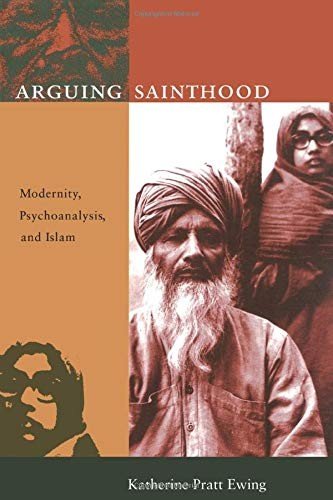
- Arguing Sainthood: Modernity, Psychoanalysis, and Islam
- ISBN
- 9780822320241
- Book Title
- Arguing Sainthood : Modernity, Psychoanalysis, and Islam
- Publisher
- Duke University Press
- Item Length
- 9 in
- Publication Year
- 1997
- Format
- Trade Paperback
- Language
- English
- Illustrator
- Yes
- Item Height
- 0.8 in
- Author
- Katherine Pratt Ewing
- Genre
- Religion, Social Science, Psychology, History
- Topic
- Movements / Psychoanalysis, Islam / History, Islam / General, Islam / Sufi, Anthropology / General, Middle East / General
- Item Weight
- 15.9 Oz
- Item Width
- 6 in
- Number of Pages
- 327 Pages
Arguing Sainthood: Modernity, Psychoanalysis, and Islam By Kathe
About this product
Product Identifiers
Publisher
Duke University Press
ISBN-10
082232024X
ISBN-13
9780822320241
eBay Product ID (ePID)
14038831399
Product Key Features
Book Title
Arguing Sainthood : Modernity, Psychoanalysis, and Islam
Number of Pages
327 Pages
Language
English
Topic
Movements / Psychoanalysis, Islam / History, Islam / General, Islam / Sufi, Anthropology / General, Middle East / General
Publication Year
1997
Illustrator
Yes
Genre
Religion, Social Science, Psychology, History
Format
Trade Paperback
Dimensions
Item Height
0.8 in
Item Weight
15.9 Oz
Item Length
9 in
Item Width
6 in
Additional Product Features
LCCN
97-014066
Reviews
“This is an important book, one that is significant for the discourses of Pakistani modernity and the dilemmas it creates, the internal differentiations in Pakistani society, and the historical forces that brought them about.” – Gananath Obeyesekere, Princeton University “Arguing Sainthood can and should be used in courses on modernity, postcolonialism, the Middle East, South Asia, and in other coursesÑcultural studies, religion – where Lacanian ideas are not unfamiliar.” – Michael M. J. Fischer, Massachusetts Institute of Technology, ” Arguing Sainthood can and should be used in courses on modernity, postcolonialism, the Middle East, South Asia, and in other courses–cultural studies, religion–where Lacanian ideas are not unfamiliar.”–Michael M. J. Fischer, Massachusetts Institute of Technology, “ Arguing Sainthood can and should be used in courses on modernity, postcolonialism, the Middle East, South Asia, and in other courses-cultural studies, religion-where Lacanian ideas are not unfamiliar.â€�-Michael M. J. Fischer, Massachusetts Institute of Technology, “This is an important book, one that is significant for the discourses of Pakistani modernity and the dilemmas it creates, the internal differentiations in Pakistani society, and the historical forces that brought them about.” – Gananath Obeyesekere, Princeton University”Arguing Sainthood can and should be used in courses on modernity, postcolonialism, the Middle East, South Asia, and in other coursescultural studies, religion – where Lacanian ideas are not unfamiliar.” – Michael M. J. Fischer, Massachusetts Institute of Technology, ” Arguing Sainthood can and should be used in courses on modernity, postcolonialism, the Middle East, South Asia, and in other courses-cultural studies, religion-where Lacanian ideas are not unfamiliar.”-Michael M. J. Fischer, Massachusetts Institute of Technology, ” Arguing Sainthood can and should be used in courses on modernity, postcolonialism, the Middle East, South Asia, and in other courses–cultural studies, religion–where Lacanian ideas are not unfamiliar.”–Michael M. J. Fischer, Massachusetts Institute of Technology “This is an important book, one that is significant for the discourses of Pakistani modernity and the dilemmas it creates, the internal differentiations in Pakistani society, and the historical forces that brought them about.”–Gananath Obeyesekere, Princeton University, “This is an important book, one that is significant for the discourses of Pakistani modernity and the dilemmas it creates, the internal differentiations in Pakistani society, and the historical forces that brought them about.”-Gananath Obeyesekere, Princeton University, “This is an important book, one that is significant for the discourses of Pakistani modernity and the dilemmas it creates, the internal differentiations in Pakistani society, and the historical forces that brought them about.”–Gananath Obeyesekere, Princeton University
Dewey Edition
21
Dewey Decimal
297
Table Of Content
Contents List of Illustrations Preface Chapter 1. Hegemony, Consciousness, and the Postcolonial Subject Part I. The Tradition-Modernity Dichotomy as a Hegemonic Discourse Chapter 2. Sadhus and Faqirs: The Sufi Pir as a Colonial Construct Chapter 3. The Pir, the State, and the Modern Subject Part II. The Modern Subject and Conflicting Ideologies Chapter 4. Everyday Arguments Chapter 5. A Pir’s Life Story Chapter 6. Stories of Desire: Reclaiming the Forgotten Pir Part III. Modern Respectability and Antinomian Desire Chapter 7. The Qalandar Confronts the Proper Muslim Chapter 8. The Qalandar as Trope Chapter 9. The Subject, Desire, and Recognition Afterword Glossary Notes References Index
Synopsis
Examines the competing forces behind the formation of a modern western subjectivity in the context of Sufi religious meanings and practices in Pakistan, In Arguing Sainthood , Katherine Pratt Ewing examines Sufi religious meanings and practices in Pakistan and their relation to the Westernizing influences of modernity and the shaping of the postcolonial self. Using both anthropological fieldwork and psychoanalytic theory to critically reinterpret theories of subjectivity, Ewing examines the production of identity in the context of a complex social field of conflicting ideologies and interests. Ewing critiques Eurocentric cultural theorists and Orientalist discourse while also taking issue with expatriate postcolonial thinkers Homi Bhabha and Gayatri Spivak. She challenges the notion of a monolithic Islamic modernity in order to explore the lived realities of individuals, particularly those of Pakistani saints and their followers. By examining the continuities between current Sufi practices and earlier popular practices in the Muslim world, Ewing identifies in the Sufi tradition a reflexive, critical consciousness that has usually been associated with the modern subject. Drawing on her training in clinical and theoretical psychoanalysis as well as her anthropological fieldwork in Lahore, Pakistan, Ewing argues for the value of Lacan in anthropology as she provides the basis for retheorizing postcolonial studies., Freddy is a little angel who loves to jump from cloud to cloud. One day he slips through a hole in the ozone and falls towards the earth, crash landing through Trudy and Sam’s roof. With the help of Professor Greenwich they soon discover that pollution caused Freddy to fall from the sky. Trudy, Sam and Professor Greenwich work together to try and help the little angel return home. They also work together to try and close that hole in the sky. Key Concept: When we work together we can accomplish great things.
LC Classification Number
BP189
Price : 5.66
Ends on : N/A
View on eBay