

Item specifics
- Condition
- Brand
- Unbranded
- MPN
- Does not apply
- ISBN
- 9780195171990
- Book Title
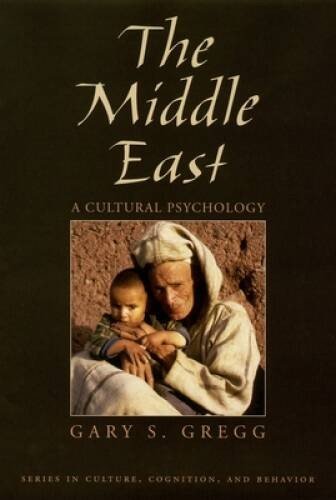
- Middle East : a Cultural Psychology
- Book Series
- Culture, Cognition, and Behavior Ser.
- Publisher
- Oxford University Press, Incorporated
- Item Length
- 6.4 in
- Publication Year
- 2005
- Format
- Hardcover
- Language
- English
- Illustrator
- Yes
- Item Height
- 1.1 in
- Author
- Gary S. Gregg
- Genre
- Religion, Social Science, Psychology
- Topic
- Ethnopsychology, Islam / General, Social Psychology, History, Sociology of Religion
- Item Weight
- 27.5 Oz
- Item Width
- 9.2 in
- Number of Pages
- 472 Pages
The Middle East: A Cultural Psychology (Culture, Cognition, and Behavior) – GOOD
About this product
Product Identifiers
Publisher
Oxford University Press, Incorporated
ISBN-10
0195171993
ISBN-13
9780195171990
eBay Product ID (ePID)
30969088
Product Key Features
Book Title
Middle East : a Cultural Psychology
Number of Pages
472 Pages
Language
English
Topic
Ethnopsychology, Islam / General, Social Psychology, History, Sociology of Religion
Publication Year
2005
Illustrator
Yes
Genre
Religion, Social Science, Psychology
Book Series
Culture, Cognition, and Behavior Ser.
Format
Hardcover
Dimensions
Item Height
1.1 in
Item Weight
27.5 Oz
Item Length
6.4 in
Item Width
9.2 in
Additional Product Features
Intended Audience
Trade
LCCN
2004-016417
Reviews
… Gregg’s book has much to recommend it. Gregg provides an encyclopaedic review of the cultural-psychology literature while seeking to reintroduce individual variation as an important variable for understanding the key issues of our times. He raises the important question of the impact of oppression, war and violence on large numbers of residents of the Middle East and North Africa, and provides a useful agenda for future research., “…Gregg explodes existing myths and stereotypes of Middle Easterners and introduces us to ethnographic accounts of their lives, relationships, goals and identities He is a reliable guide to a hot and controversial terrain. I found the book illuminating and full of surprises, and I recommendit to anyone seeking a deeper understanding of Middle Easterners than is available from journalistic sources.” –Robert A. LeVine, Roy E. Larsen Professor of Education and Human Development, Emeritus Harvard University, “…Gregg explodes existing myths and stereotypes of Middle Easterners andintroduces us to ethnographic accounts of their lives, relationships, goals andidentities He is a reliable guide to a hot and controversial terrain. I foundthe book illuminating and full of surprises, and I recommend it to anyoneseeking a deeper understanding of Middle Easterners than is available fromjournalistic sources.” –Robert A. LeVine, Roy E. Larsen Professor of Educationand Human Development, Emeritus Harvard University, “Gregg contributes a superb work that combines a much needed focus on the Middle East with a wide cultural psychology framework that gives weight to emotion as well as cognition and that acknowledges the richness of ethnographies and life histories accessing subjective experience as well asthe measurement of psychological attitudes.” –Mary-Jo DelVecchio Good, Professor of Social Medicine and member of the Center for Middle Eastern Studies and the Weatherhead Center for International Affairs, Harvard University, “The publishers are to be commended for producing a book in a discipline widely considered to be passe, but which deserves reconsideration. Gregg provides an encyclopedic review of the cultural-psychology literature while seeking to reintroduce individual variation as an important variablefor understanding the key issues of our times. He raises the important question of the impact of oppression, war and violence on large numbers of residents of the Middle East and North Africa, and provides a useful agenda for future research.”–Nature, “Gregg has provided an engaging, thoughtful, and wide-ranging discussion that should be read by students and scholars interested in the very important cultural transformations taking place in the Near and Middle East.” –Fathali Moghaddam, Professor of Psychology, Georgetown University, “This original and timely book explores the life trajectories of men and women in the Middle East and North Africa from a psychocultural point of view.[It] will prove indispensable for anyone attempting to understand how Middle Easterners and North Africans are trying to cope with the strugglebetween the old and the new in their respective societies and their daily lives.” –Uwe P. Gielen, Professor of Psychology, St. Francis College, Brooklyn, New York, “…a thoroughly researched analysis of the cultural psychology of people in the Middle East.” — The Muslim World Book Review, “…offers scholarly but reader-friendly descriptions and interpretations of cultures, societies, and psychological development of the people in the regions of the Middle East and North Africa…. It is a timely and worthwhile read.” –PsycCRITIQUES “Gregg has provided an engaging, thoughtful, and wide-ranging discussion that should be read by students and scholars interested in the very important cultural transformations taking place in the Near and Middle East.” –Fathali Moghaddam, Professor of Psychology, Georgetown University “This original and timely book explores the life trajectories of men and women in the Middle East and North Africa from a psychocultural point of view.[It] will prove indispensable for anyone attempting to understand how Middle Easterners and North Africans are trying to cope with the struggle between the old and the new in their respective societies and their daily lives.” –Uwe P. Gielen, Professor of Psychology, St. Francis College, Brooklyn, New York “Gregg contributes a superb work that combines a much needed focus on the Middle East with a wide cultural psychology framework that gives weight to emotion as well as cognition and that acknowledges the richness of ethnographies and life histories accessing subjective experience as well as the measurement of psychological attitudes.” –Mary-Jo DelVecchio Good, Professor of Social Medicine and member of the Center for Middle Eastern Studies and the Weatherhead Center for International Affairs, Harvard University “…Gregg explodes existing myths and stereotypes of Middle Easterners and introduces us to ethnographic accounts of their lives, relationships, goals and identities He is a reliable guide to a hot and controversial terrain. I found the book illuminating and full of surprises, and I recommend it to anyone seeking a deeper understanding of Middle Easterners than is available from journalistic sources.” –Robert A. LeVine, Roy E. Larsen Professor of Education and Human Development, Emeritus Harvard University “Gregg has provided an engaging, thoughtful, and wide-ranging discussion that should be read by students and scholars interested in the very important cultural transformations taking place in the Near and Middle East.” –Fathali Moghaddam, Professor of Psychology, Georgetown University “The author is undoubtedly aware of the complexities and problems plaguing the area, and displays a welcomed sensitivity in writing about it.”–Middle East Journal “The publishers are to be commended for producing a book in a discipline widely considered to be passe, but which deserves reconsideration. Gregg provides an encyclopedic review of the cultural-psychology literature while seeking to reintroduce individual variation as an important variable for understanding the key issues of our times. He raises the important question of the impact of oppression, war and violence on large numbers of residents of the Middle East and North Africa, and provides a useful agenda for future research.”–Nature “…a thoroughly researched analysis of the cultural psychology of people in the Middle East.” –The Muslim World Book Review, “…offers scholarly but reader-friendly descriptions and interpretations of cultures, societies, and psychological development of the people in the regions of the Middle East and North Africa…. It is a timely and worthwhile read.” –PsycCRITIQUES”Gregg has provided an engaging, thoughtful, and wide-ranging discussion that should be read by students and scholars interested in the very important cultural transformations taking place in the Near and Middle East.” –Fathali Moghaddam, Professor of Psychology, Georgetown University”This original and timely book explores the life trajectories of men and women in the Middle East and North Africa from a psychocultural point of view.[It] will prove indispensable for anyone attempting to understand how Middle Easterners and North Africans are trying to cope with the struggle between the old and the new in their respective societies and their daily lives.” –Uwe P. Gielen, Professor of Psychology, St. Francis College, Brooklyn, New York”Gregg contributes a superb work that combines a much needed focus on the Middle East with a wide cultural psychology framework that gives weight to emotion as well as cognition and that acknowledges the richness of ethnographies and life histories accessing subjective experience as well as the measurement of psychological attitudes.” –Mary-Jo DelVecchio Good, Professor of Social Medicine and member of the Center for Middle Eastern Studies and the Weatherhead Center for International Affairs, Harvard University”…Gregg explodes existing myths and stereotypes of Middle Easterners and introduces us to ethnographic accounts of their lives, relationships, goals and identities He is a reliable guide to a hot and controversial terrain. I found the book illuminating and full of surprises, and I recommend it to anyone seeking a deeper understanding of Middle Easterners than is available from journalistic sources.” –Robert A. LeVine, Roy E. Larsen Professor of Education and Human Development, Emeritus Harvard University”Gregg has provided an engaging, thoughtful, and wide-ranging discussion that should be read by students and scholars interested in the very important cultural transformations taking place in the Near and Middle East.” –Fathali Moghaddam, Professor of Psychology, Georgetown University”The author is undoubtedly aware of the complexities and problems plaguing the area, and displays a welcomed sensitivity in writing about it.”–Middle East Journal”The publishers are to be commended for producing a book in a discipline widely considered to be passe, but which deserves reconsideration. Gregg provides an encyclopedic review of the cultural-psychology literature while seeking to reintroduce individual variation as an important variable for understanding the key issues of our times. He raises the important question of the impact of oppression, war and violence on large numbers of residents of the Middle East and North Africa, and provides a useful agenda for future research.”–Nature”…a thoroughly researched analysis of the cultural psychology of people in the Middle East.” — The Muslim World Book Review, “…offers scholarly but reader-friendly descriptions and interpretations of cultures, societies, and psychological development of the people in the regions of the Middle East and North Africa…. It is a timely and worthwhile read.” –PsycCRITIQUES, …”offers scholarly but reader-friendly descriptions and interpretations of cultures, societies, and psychological development of the people in the regions of the Middle East and North Africa…. It is a timely and worthwhile read.” –PsycCRITIQUES “Gregg has provided an engaging, thoughtful, and wide-ranging discussion that should be read by students and scholars interested in the very important cultural transformations taking place in the Near and Middle East.” –Fathali Moghaddam, Professor of Psychology, Georgetown University “This original and timely book explores the life trajectories of men and women in the Middle East and North Africa from a psychocultural point of view.ÝIt¨ will prove indispensable for anyone attempting to understand how Middle Easterners and North Africans are trying to cope with the struggle between the old and the new in their respective societies and their daily lives.” –Uwe P. Gielen, Professor of Psychology, St. Francis College, Brooklyn, New York “Gregg contributes a superb work that combines a much needed focus on the Middle East with a wide cultural psychology framework that gives weight to emotion as well as cognition and that acknowledges the richness of ethnographies and life histories accessing subjective experience as well as the measurement of psychological attitudes.” –Mary-Jo DelVecchio Good, Professor of Social Medicine and member of the Center for Middle Eastern Studies and the Weatherhead Center for International Affairs, Harvard University …”Gregg explodes existing myths and stereotypes of Middle Easterners and introduces us to ethnographic accounts of their lives, relationships, goals and identities He is areliable guide to a hot and controversial terrain. I found the book illuminating and full of surprises, and I recommend it to anyone seeking a deeper understanding of Middle Easterners than is available from journalistic sources.” –Robert A. LeVine, Roy E. Larsen Professor of Education and Human Development, Emeritus Harvard University “Gregg has provided an engaging, thoughtful, and wide-ranging discussion that should be read by students and scholars interested in the very important cultural transformations taking place in the Near and Middle East.” –Fathali Moghaddam, Professor of Psychology, Georgetown University “The author is undoubtedly aware of the complexities and problems plaguing the area, and displays a welcomed sensitivity in writing about it.”–Middle East Journal “The publishers are to be commended for producing a book in a discipline widely considered to be passe, but which deserves reconsideration. Gregg provides an encyclopedic review of the cultural-psychology literature while seeking to reintroduce individual variation as an important variable for understanding the key issues of our times. He raises the important question of the impact of oppression, war and violence on large numbers of residents of the Middle East and North Africa, and provides a useful agenda for future research.”–Nature, “…offers scholarly but reader-friendly descriptions and interpretations of cultures, societies, and psychological development of the people in the regions of the Middle East and North Africa…. It is a timely and worthwhile read.” –PsycCRITIQUES “Gregg has provided an engaging, thoughtful, and wide-ranging discussion that should be read by students and scholars interested in the very important cultural transformations taking place in the Near and Middle East.” –Fathali Moghaddam, Professor of Psychology, Georgetown University “This original and timely book explores the life trajectories of men and women in the Middle East and North Africa from a psychocultural point of view.[It] will prove indispensable for anyone attempting to understand how Middle Easterners and North Africans are trying to cope with the struggle between the old and the new in their respective societies and their daily lives.” –Uwe P. Gielen, Professor of Psychology, St. Francis College, Brooklyn, New York “Gregg contributes a superb work that combines a much needed focus on the Middle East with a wide cultural psychology framework that gives weight to emotion as well as cognition and that acknowledges the richness of ethnographies and life histories accessing subjective experience as well as the measurement of psychological attitudes.” –Mary-Jo DelVecchio Good, Professor of Social Medicine and member of the Center for Middle Eastern Studies and the Weatherhead Center for International Affairs, Harvard University “…Gregg explodes existing myths and stereotypes of Middle Easterners and introduces us to ethnographic accounts of their lives, relationships, goals and identities He is a reliable guide to a hot and controversial terrain. I found the book illuminating and full of surprises, and I recommend it to anyone seeking a deeper understanding of Middle Easterners than is available from journalistic sources.” –Robert A. LeVine, Roy E. Larsen Professor of Education and Human Development, Emeritus Harvard University “Gregg has provided an engaging, thoughtful, and wide-ranging discussion that should be read by students and scholars interested in the very important cultural transformations taking place in the Near and Middle East.” –Fathali Moghaddam, Professor of Psychology, Georgetown University “The author is undoubtedly aware of the complexities and problems plaguing the area, and displays a welcomed sensitivity in writing about it.”–Middle East Journal “The publishers are to be commended for producing a book in a discipline widely considered to be passe, but which deserves reconsideration. Gregg provides an encyclopedic review of the cultural-psychology literature while seeking to reintroduce individual variation as an important variable for understanding the key issues of our times. He raises the important question of the impact of oppression, war and violence on large numbers of residents of the Middle East and North Africa, and provides a useful agenda for future research.”–Nature “…a thoroughly researched analysis of the cultural psychology of people in the Middle East.” — The Muslim World Book Review, “The publishers are to be commended for producing a book in a disciplinewidely considered to be passe, but which deserves reconsideration. Greggprovides an encyclopedic review of the cultural-psychology literature whileseeking to reintroduce individual variation as an important variable forunderstanding the key issues of our times. He raises the important question ofthe impact of oppression, war and violence on large numbers of residents of theMiddle East and North Africa, and provides a useful agenda for futureresearch.”–Nature, “The author is undoubtedly aware of the complexities and problems plaguing the area, and displays a welcomed sensitivity in writing about it.”–Middle East Journal, … Gregg’s book has much to recommend it. Gregg provides and encyclopaedic review of the cultural-psychology literature while seeking to reintroduce individual variation as an important variable for understanding the key issues of our times. He raises the important question of the impact of oppression, war and violence on large numbers of residents of the Middle East and North Africa, and provides a useful agenda for future research.
TitleLeading
The
Dewey Edition
22
Dewey Decimal
155.820956
Table Of Content
Foreword by David MatsumotoIntroductionPart I. Cultural context of development1. Misunderstandings2. The social ecology of psychological development3. Honor and Islam: Shaping emotions, traits, and selvesPart II. Periods of psychological developmentIntroduction to Part II4. Childbirth and infant care5. Early childhood6. Late childhood7. Adolescence8. Earlt adulthood and identity9. Mature adulthood10. Patterns and lives: Development through the life-spanAfterword: A research agenda
Synopsis
For over a decade the Middle East has monopolized news headlines in the West. Journalists and commentators regularly speculate that the region’s turmoil may stem from the psychological momentum of its cultural traditions or of a “tribal” or “fatalistic” mentality. Yet few studies of the region’s cultural psychology have provided a critical synthesis of psychological research on Middle Eastern societies. Drawing on autobiographies, literary works, ethnographic accounts, and life-history interviews, The Middle East: A Cultural Psychology , offers the first comprehensive summary of psychological writings on the region, reviewing works by psychologists, anthropologists, and sociologists that have been written in English, Arabic, and French. Rejecting stereotypical descriptions of the “Arab mind” or “Muslim mentality, ‘ Gary Gregg adopts a life-span- development framework, examining influences on development in infancy, early childhood, late childhood, and adolescence as well as on identity formation in early and mature adulthood. He views patterns of development in the context of recent work in cultural psychology, and compares Middle Eastern patterns less with Western middle class norms than with those described for the region’s neighbors: Hindu India, sub-Saharan Africa, and the Mediterranean shore of Europe. The research presented in this volume overwhelmingly suggests that the region’s strife stems much less from a stubborn adherence to tradition and resistance to modernity than from widespread frustration with broken promises of modernization–with the slow and halting pace of economic progress and democratization. A sophisticated account of the Middle East’s cultural psychology, The Middle East provides students, researchers, policy-makers, and all those interested in the culture and psychology of the region with invaluable insight into the lives, families, and social relationships of Middle Easterners as they struggle to reconcile the lure of Westernized life-styles with traditional values., For over a decade the Middle East has monopolized news headlines in the West. Journalists and commentators regularly speculate that the region’s turmoil may stem from the psychological momentum of its cultural traditions or of a “tribal” or “fatalistic” mentality. Yet few studies of the region’s cultural psychology have provided a critical synthesis of psychological research on Middle Eastern societies. Drawing on autobiographies, literary works, ethnographic accounts, and life-history interviews, The Middle East: A Cultural Psychology offers the first comprehensive summary of psychological writings on the region, covering works by psychologists, anthropologists, and sociologists written in English, Arabic, and French. Rejecting stereotypic descriptions of the “Arab mind” or “Muslim mentality,” Gary Gregg adopts a life-span development framework, examining influences on development in the context of recent work in cultural psychology, and compares Middle Eastern patterns less with Western middle class norms than with those described for the region’s neighbors: Hindu India, sub-Saharan Africa, and the Mediterranean shore of Europe. The psychological writings overwhelmingly suggest that the region’s strife stems much less from a stubborn adherence to tradition and resistance to modernity than from widespread frustration with broken promises of modernization – with the slow and halting pace of economic progress and democratization. A sophisticated account of the Middle East’s cultural psychology, this book provides students, researchers, policy-makers, and all those interested in the culture and psychology of the region with invaluable insight into the lives, families, and social relationships of Middle Easterners as they struggle to reconcile the lure of Westernized life-styles with traditional values., For over a decade the Middle East has monopolized news headlines in the West. Journalists and commentators regularly speculate that the region’s turmoil may stem from the psychological momentum of its cultural traditions or of a “tribal” or “fatalistic” mentality. Yet few studies of the region’s cultural psychology have provided a critical synthesis of psychological research on Middle Eastern societies. Drawing on autobiographies, literary works, ethnographic accounts, and life-history interviews, The Middle East: A Cultural Psychology, offers the first comprehensive summary of psychological writings on the region, reviewing works by psychologists, anthropologists, and sociologists that have been written in English, Arabic, and French. Rejecting stereotypical descriptions of the “Arab mind” or “Muslim mentality,’ Gary Gregg adopts a life-span- development framework, examining influences on development in infancy, early childhood, late childhood, and adolescence as well as on identity formation in early and mature adulthood. He views patterns of development in the context of recent work in cultural psychology, and compares Middle Eastern patterns less with Western middle class norms than with those described for the region’s neighbors: Hindu India, sub-Saharan Africa, and the Mediterranean shore of Europe. The research presented in this volume overwhelmingly suggests that the region’s strife stems much less from a stubborn adherence to tradition and resistance to modernity than from widespread frustration with broken promises of modernization–with the slow and halting pace of economic progress and democratization. A sophisticated account of the Middle East’s cultural psychology, The Middle East provides students, researchers, policy-makers, and all those interested in the culture and psychology of the region with invaluable insight into the lives, families, and social relationships of Middle Easterners as they struggle to reconcile the lure of Westernized life-styles with traditional values., The first comprehensive summary of psychological studies of Arab-Muslim societies, this book examines psychological development through the life-span, describing how traditional patterns appear to be changing in both “modernizing” and “underdeveloping” sectors of Middle Eastern societies. It provides a scholarly account of the region’s cultural psychology, and also offers insight into the daily lives of parents, children, and families as they struggle behind and sometimes in the headlines to modernize while conserving valued traditions.
LC Classification Number
GN502.G76 2005
Price : 7.76
Ends on : N/A
View on eBay