
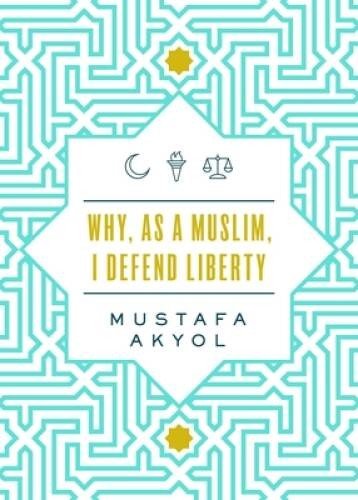

Item specifics
- Condition
- Brand
- Unbranded
- MPN
- Does not apply
- ISBN
- 9781952223174
- Book Title
- Why, As a Muslim, I Support Liberty
- Publisher
- Cato Institute
- Item Length
- 7.1 in
- Publication Year
- 2021
- Format
- Trade Paperback
- Language
- English
- Illustrator
- Yes
- Item Height
- 0.6 in
- Author
- Mustafa Akyol
- Genre
- Religion, Political Science, Philosophy
- Topic
- Islam / History, Religious, General, World / Middle Eastern
- Item Weight
- 6.6 Oz
- Item Width
- 5.1 in
- Number of Pages
- 192 Pages
Why, as a Muslim, I Defend Liberty – Paperback By Akyol, Mustafa – VERY GOOD
About this product
Product Identifiers
Publisher
Cato Institute
ISBN-10
1952223172
ISBN-13
9781952223174
eBay Product ID (ePID)
10050421694
Product Key Features
Book Title
Why, As a Muslim, I Support Liberty
Number of Pages
192 Pages
Language
English
Publication Year
2021
Topic
Islam / History, Religious, General, World / Middle Eastern
Illustrator
Yes
Genre
Religion, Political Science, Philosophy
Format
Trade Paperback
Dimensions
Item Height
0.6 in
Item Weight
6.6 Oz
Item Length
7.1 in
Item Width
5.1 in
Additional Product Features
Intended Audience
Trade
LCCN
2021-939010
Reviews
In this highly readable and timely book, Akyol traces manifestations of individual liberty and social, economic, and political freedoms in ways in which Islam has been lived through history. He sees Islam as an intellectual debate rather than an immutable code, and hence open to interpretation. This is an important contribution to the debate over the future of the Muslim world. It is a must-read for Muslims and non-Muslims., “This is an original and powerful manifesto for the compatibility of Islam and individual liberty. Mustafa Akyol convincingly articulates a freedom-focused interpretation of Islam by offering new perspectives on controversial issues such as Sharia, the Islamic legacy of military conquests, and freedom of speech in Muslim societies. He invites the readers to rethink Muslim history, theology, and politics, as well as some biases and cliches of the modern age.”–Ahmet T. Kuru, author of Islam, Authoritarianism, and Underdevelopment: A Global and Historical Comparison In this highly readable and timely book, Akyol traces manifestations of individual liberty and social, economic, and political freedoms in ways in which Islam has been lived through history. He sees Islam as an intellectual debate rather than an immutable code, and hence open to interpretation. This is an important contribution to the debate over the future of the Muslim world. It is a must-read for Muslims and non-Muslims.”–Vali Nasr, author of Shia Revival: How Conflicts within Islam Will Shape the Future
Table Of Content
Introduction: Why Liberty Matters Is There Some Compulsion in Islam? Why We Need to Rethink the Shariah Why We Need to Revive the Shariah Will Islam “Conquer” and “Prevail”? Should Muslims “Obey” Anybody? What To Do With Un-Islamic Speech Islam’s Lost Heritage of Economics Liberty Is Liberty a Western Conspiracy? Epilogue What to Read Next?
Synopsis
Islam, the second largest religion in the world, has several authoritarian interpretations today that defy human freedom–by executing “apostates” or “blasphemers,” imposing religious practices, or discriminating against women or minorities. In Why, as a Muslim, I Support Liberty, Mustafa Akyol offers a bold critique of this trouble, by frankly acknowledging its roots in the religious tradition.But Akyol also shows that Islam has “seeds of freedom” as well–in the Qur’an, the life of the Prophet Muhammad, and the complex history of the Islamic civilization. It is past time, he argues, to grow those seeds into maturity, and reinterpret Islamic law and politics under the Qur’anic maxim, “No compulsion in religion.”Akyol shows that the major reinterpretation Islam needs now is similar to the transformation that began in Western Christianity back in the 17th century, with the groundbreaking ideas of classical liberal thinkers such as John Locke. The author goes back and forth between classical liberalism and the Islamic tradition, to excavate little-noticed parallels, first highlighted by the “Islamic liberals” of the late Ottoman Empire, unknown to many Muslims and non-Muslims today. In short chapters, Akyol digs into big questions. Why do Muslims need to “reform” the Sharia? But is there something to “revive” in the Sharia as well? Should Muslims really glorify “conquest,” or rather believe in social contract? Is capitalism really alien to Islam, which has a rich heritage of free markets and civil society? Finally, he addresses a suspicion common among Muslims today: What if liberty is a mere cover used by Western powers to advance their imperialist schemes? With personal stories, historical anecdotes, theological insights, and a very accessible prose, this is the little big book on the intersection of Islam and liberty., This short but accessible book provides an argument that the Lockean revolution in Christianity–which reconciled faith with freedom–is both desperately necessary and also promisingly possible in Islam., The recent news from Afghanistan, where the Taliban seized power once again to rule in the name of God, brings to mind a broader trouble: Islam, the second-largest religion in the world, has some harsh interpretations that defy human freedom–by imposing religious practices, discriminating against women or minorities, or executing “apostates” or “blasphemers.” In Why, as a Muslim, I Defend Liberty , Cato Institute senior fellow Mustafa Akyol offers a bold critique of this trouble by frankly acknowledging its roots in the religious tradition, while also presenting counterarguments. Akyol argues that liberty is compatible with Islam if it is understood as a voluntary faith and not a coercive system, as many Muslims already see it. However, other Muslims understand Islam, indeed, as a coercive system that sees no difference between what is religiously right and legally enforceable. Moreover, these coercive Muslims’ beliefs are not groundless: they rely on traditional interpretations of the Sharia (Islamic law). Yet the two fundamental sources of the Sharia–the Quran and the Prophetic example–also include seeds of freedom, Akyol argues. He explores little-noticed grounds for human rights, toleration and rule of law in the Quran, the life of the Prophet Muhammad, and the complex history of the Islamic civilization. It is past time, he argues, to grow those seeds into maturity and to reinterpret Islamic law and politics under the Quranic maxim, “No compulsion in religion.” In short chapters, Akyol digs into big questions: Why do Muslims need to reform the Sharia? Is there something to revive in the Sharia? Should Muslims really glorify conquest and supremacy, or instead, believe in the social contract? Is capitalism really alien to Islam, which has a rich heritage of free markets and civil society? Finally, he addresses a suspicion common among Muslims today: What if liberty is a mere cover used by Western powers to advance their imperialist schemes? With personal stories, historical anecdotes, and theological insights, this is the little big book on the intersection of Islam and liberty.
LC Classification Number
MLCS 2024/40531 (B)
Price : 4.29
Ends on : N/A
View on eBay